
San Marcos Resident Lookup Records
The official record trail does not draw from one San Marcos list. Each record instead documents a narrower relationship. Start with the record most closely tied to the fact being checked, then use a second independent anchor before connecting a name to a place or date. The Hays County record systems also cover unincorporated addresses and nearby communities, so the county result and its stated location must be read together.
| Record | What It Confirms | Where | Access |
|---|---|---|---|
| Property appraisal or GIS record | Owner, account, parcel, situs, or mailing relationship | Hays CAD and Hays GIS | Public search; owner or mailing data do not prove occupancy |
| Voter registration lookup | Election-specific registration result for an authorized query | Hays voter lookup | Identity-gated official query with privacy controls |
| Court index | Party, cause, court, and case relationship | Hays Odyssey or the District Clerk | Portal and counter routes; sealed material may not appear |
| Vital record | Recorded Texas life event under the applicable access rule | Hays County Clerk or Texas DSHS | Time-gated or restricted; certified copies follow custodian rules |
| Business filing or license record | Public entity, credential, or filing relationship | Texas SOSDirect or the relevant state board | Record-specific; not evidence of private residence |
For an old name and address, begin with historical directories or an obituary index. For a court question, begin with the relevant court module. For a parcel question, begin with CAD or GIS. This keeps the result tied to the claim a source can actually support.
San Marcos Record Evidence
The strongest result is not the longest search result. CAD and GIS can connect an owner or mailing name to a parcel, but neither proves that the person lives there now. A voter result is election-specific. A court party is connected to a case, not automatically to a San Marcos address. A directory entry identifies a person at the directory’s date. Each source needs its own date, custodian, and confidence boundary.
Normalize the name before searching. Check initials, middle names, suffixes, accents, former names, and common misspellings. Set a date range and a location hypothesis. Then require two independent anchors, such as address plus year, spouse or family relationship plus obituary date, or cause number plus court. A shared surname, telephone line, common street, or mailing address is not enough to merge two people.
Note: “No result” means no result in that portal or date range, not proof that a person lacks a San Marcos connection.
San Marcos CAD Record Fields
Hays CAD is an appraisal search, so use its fields to identify a San Marcos account or parcel and then state that limited result plainly. The inspected search offers owner name, street number, Quick Ref ID, owner ID, street name, subdivision, condo, property type, tax year, neighborhood, and related fields. Several controls use autocomplete, and the available select options were not exposed during the static inspection.
| Owner Name | Tests an owner spelling or variant against an appraisal account |
|---|---|
| Street Number and Street Name | Locates a parcel by its stated street components, not a broad personal list |
| Quick Ref ID or Owner ID | Uses the CAD identifier shown with an account or owner record |
| Subdivision, Condo, and Property Type | Helps distinguish similar addresses or parcel contexts |
| Tax Year and Neighborhood | Places an appraisal record in its stated tax year and local CAD context |
Preliminary current-year values can change. A legal description, acreage, title question, or present-occupancy claim needs the appropriate underlying record rather than a CAD screen alone.
Verify a San Marcos Resident Record
To look up a resident responsibly, build a short San Marcos provenance trail rather than combining records into one untested claim. Preserve the source URL, record type, retrieval date, search terms, and exact displayed text. An older directory or burial reference can establish a historical lead, while a current dated custodian record can test a current record relationship. Do not silently convert either into a claim of current occupancy.
- Write down the name variant, a year, and the known San Marcos address or record context.
- Search Hays CAD, tax, or GIS for the parcel or owner spelling, and label the result as an account or parcel relationship.
- Check the matching court or vital-record route only for the specific record question, preserving the cause number or event type rather than copying unrelated personal data.
- Use a second dated anchor, such as a historical directory, obituary, cemetery entry, recorded instrument, or certified clerk copy when the first result is ambiguous.
- Record gaps and conflicting facts. A mismatch may reflect a different person, a changed name, an older address, or a source limit.
- Docket
- A court’s running case record, usually showing filings, events, and case identifiers. It does not decide guilt, liability, or current status by itself.
- Index and image
- An index points to a record. An underlying image or paper file is the item to inspect when wording, signature, or complete context matters.
- Certified copy
- A copy issued by the record custodian with its official certification. It is requested from the clerk or other custodian, not inferred from a portal listing.
San Marcos Court Records
Hays Odyssey Public Access begins with modules for Criminal Case Records, Civil/Family/Probate Case Records, Court Calendar, Jail Records, and Jail Bond Records. Select the module that matches the record, then preserve the party name as shown, cause number, case type, filing date, disposition date, and bond information where displayed. The exact live result fields were not exposed during the research pass, so a San Marcos court portal should not be represented as a fixed result form.
The Hays County District Clerk supplies the counter and request alternative. Public terminals are available at reception during business hours. The office will search civil and criminal records from the past ten years for $5 per name, with up to five business days for the search. Its free online name search can show the documented result inventory below. Copies cost $1 for the first ten pages and $0.10 for each additional electronic page. Certified copies are $1 per page, and an embossed seal is $5.
| Parties | Names associated with the case, not a residential finding |
|---|---|
| Cause number | The case identifier used to distinguish similar names |
| Case type and filing date | The proceeding category and recorded start date |
| Summary and bond company | Fields the District Clerk describes for its online name search when applicable |
| Disposition date | A dated case outcome field, not a broad statement about a person |
The District Clerk request page sets out the public-terminal, fee, and mail procedures for San Marcos searches and copies.
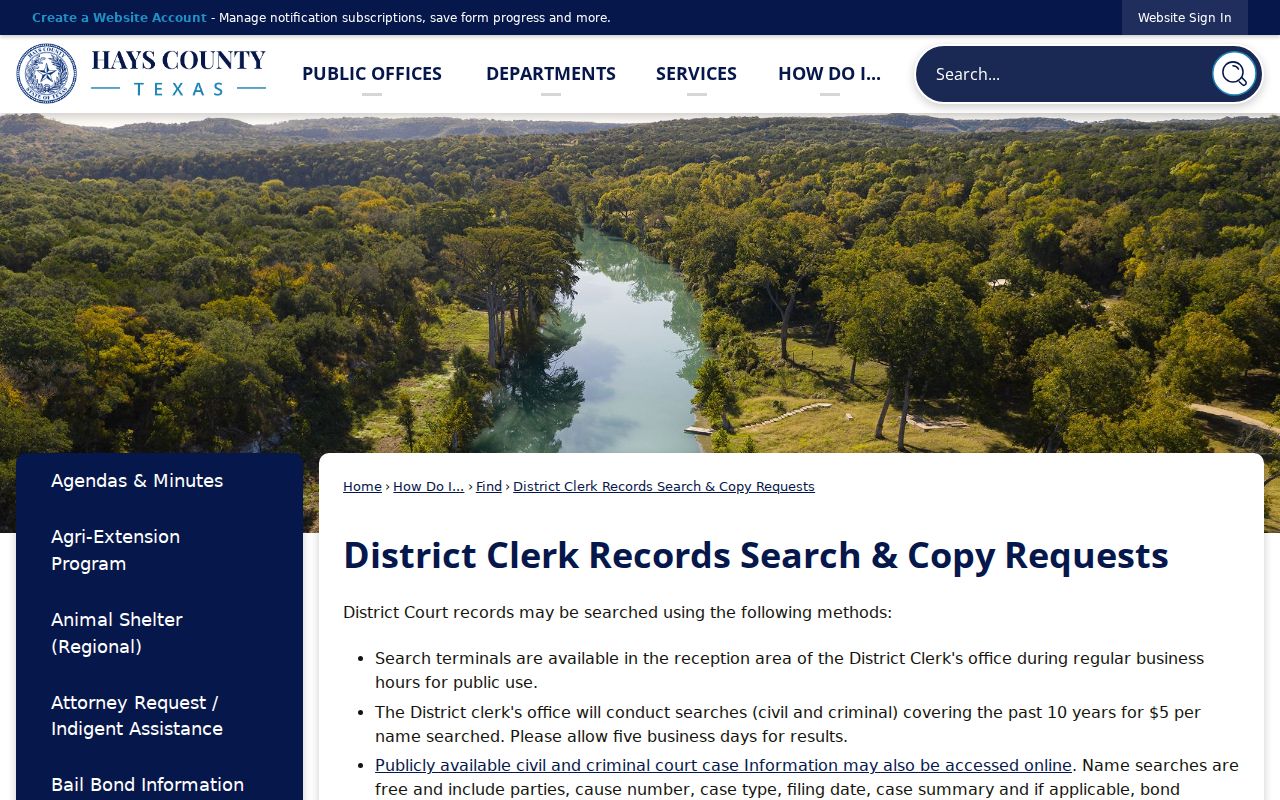
For mail requests, use Hays County District Clerk, 712 S Stagecoach Trail, Suite 2211, San Marcos, TX 78666. Obtain a quote and follow the office payment route before requesting copies; email results or a certificate may be sent, and fulfilled copies are mailed within two working days.
Note: A court index points to a case relationship; only the proper custodian can provide a certified copy or explain a restriction.
San Marcos Vital Records
Texas vital records have a different purpose and access boundary from a name search. For a San Marcos life event, first identify the correct custodian. Under Texas Government Code §552.115, a birth record becomes public on the 75th anniversary of birth and a death record on the 25th anniversary of death, subject to the statute. Recent birth and death records are restricted. The Hays County Clerk provides county-held routes and certified marriage copies, while a certified divorce decree comes from the District Clerk.
DSHS OVRA accepts Texas-event orders from requesters 18 or older. The research records typical processing of 20–25 business days and notes that orders are non-refundable. DSHS distinguishes a verification letter from a certified copy, so choose the document type needed before placing an order. A vital order should never be used as an informal route around eligibility rules.
Note: Check eligibility and identity requirements with the county or state custodian at order time because those procedures can change.
San Marcos Historical Records
When the question is about a former classmate, an ancestor, or an older household, San Marcos historical collections are usually a better fit than a current-name guess. The city library’s Local History Collection provides telephone directories, obituary indexes, cemetery inscriptions, photographs, and newspapers. The collection is particularly useful for a dated address or family relationship, but each scan must be verified for its year, page, and printed place.
Texas State University’s San Marcos Telephone Directories span 1918–2019 and include surrounding communities. A historical directory entry does not establish a person’s present location. For that historical shelf and its reading method, use the San Marcos city directory collections rather than combining old and current records into one conclusion.
San Marcos Records Requests
If an official portal does not carry the record, ask the custodian for a defined record series, date span, or case number. Texas’s Public Information Act, Government Code chapter 552, is the statewide route for public-information requests. A narrow San Marcos request to the City, Hays County Clerk, or another proper custodian is more useful than a request for a broad collection of personal data.
County custody matters. The County Clerk holds deeds, liens, births, deaths, marriages, and County Courts at Law records, while the District Clerk holds district civil and criminal matters, family and divorce records, and the naturalization index. A clerk can also explain whether a requested record is sealed, confidential, redacted, or held elsewhere.
San Marcos Record Limits
Texas protects important parts of a person’s record trail. Social Security numbers and Texas driver-license or ID numbers are not ordinary public voter fields; voter phone numbers have copying and transcription limits; and protected addresses may be withheld under Election Code protections. Court files can be sealed, expunged, confidential, or redacted. Juvenile and protected victim information may be absent. An absence can reflect a protection or source boundary, not a lack of a local connection.
The Texas Attorney General’s Address Confidentiality Program provides an official substitute-address route for qualifying survivors. Protected voter data is handled through the county registrar under the prescribed form and documentation process. For a San Marcos correction, sealing question, redaction, or confidentiality request, contact the custodian that holds the specific record instead of seeking removal from an unrelated source.
Lawful use. Use San Marcos records only for lawful personal research and record verification. Do not use records to stalk, harass, intimidate, or disclose protected details about any person.
San Marcos Filing Records
Business filings may resolve a public entity question, but they do not establish where a person lives. Texas SOSDirect charges $1 per search and supports entity, registered-agent, officer or director, LLC member or manager, and limited-partner general-partner searches. It can be useful for tracing an entity name or filing history.
A registered-agent address is a filing relationship, not proof of a San Marcos residence. Keep a filing result separate from a parcel, court, directory, or voter record, and require two independent anchors before making a name match.