
San Marcos City Directory Collections
These San Marcos directory collections survive in several formats, so the first task is choosing the collection that fits the date. The City of San Marcos Local History Collection links its ResCarta materials to early telephone directories, obituaries, cemetery inscriptions, photographs, and cataloged physical items that are not all digitized. ResCarta searches family names, geography, street or address terms, and phrases. The city’s digitized telephone-directory run reaches from 1899 through 1954. Texas State University and UT Austin add different issue-level holdings, so an apparent gap at one repository is a reason to check the other, not proof that no volume exists.
| Collection | Years | Where Held | Access |
|---|---|---|---|
| City digitized telephone directories | 1899–1954 | San Marcos Local History / ResCarta | Search the digital collection; verify the scanned page |
| San Marcos Telephone Directories, SMH-002 | 1918–2019 | Texas State University, Alkek Library Archives | Open to researchers; advance notice may be needed for off-site material |
| San Marcos Telephone Company issues | 1922, 1932, 1960, 1964–1970, 1971–1976, 1978–1992 | UT Austin Barker Texas History Collections | Issue-level holdings citation |
| Obituary, cemetery, and newspaper leads | Early twentieth century into the 1980s for obituaries | San Marcos Local History and Hays County Historical Commission | Digital pointers plus local holdings and microfilm |
Coverage is not one uninterrupted run. Some material is a catalog record rather than a visible scan, and the city collection includes directory formats that do not read like a later alphabetical volume. Cite the repository, year, page or image, and printed place for every result.
Note: A missing year at one archive can be a holdings gap, not evidence that San Marcos had no directory for that year.
San Marcos Directory Research Desk
The library’s Local History Collection supplies the practical fallback when a screen search ends at a catalog entry. It is at 625 E Hopkins St., and its listed phone is 512-393-8200. Listed hours are Monday through Thursday 9–9, Friday 9–6, Saturday 10–6, and Sunday 1–6. Staff can answer quick local-history or genealogy questions and point researchers toward the right series. More involved research may require work in the collection itself.
For older county context, the Hays County Historical Commission maintains cemetery and historic-site resources and supports the Historic Courthouse Museum. The library bibliography also identifies local newspapers and microfilm. An obituary index is a finding tool, not the notice itself, so retain the newspaper title, date, and page with the index entry.
Note: A cataloged item confirms that a repository holds something, but only a page-by-page inspection establishes the printed name, address, or notation.
San Marcos Directory Beginnings
The earliest directory material has an important limit: the 1899 telephone directory is described as a single printed sheet. It should be treated as a service list with its own headings and scope, not as a complete roll of every San Marcos household. Two early telephone companies operated from 1905, another reason to record the company named on the sheet before comparing it to a later directory.
This local quirk makes absence meaningful only after the format has been checked. A name missing from one sheet may reflect the telephone service, the printed place, or how that issue was arranged. It does not establish that the person had no San Marcos connection. The city history material reports scans through 1954, while the university archive extends the chronological shelf into 2019.
San Marcos Directory Archives
The Texas State University finding aid for SMH-002 lists San Marcos Telephone Directories from 1918 to 2019. The collection includes chronological issues, Yellow Pages, a separate Martindale section, and material for surrounding communities. Its listed creators include San Marcos Telephone Company, Verizon, YellowBook, CenturyLink, and Polk City Directories. The materials are open to researchers, while copyright and publication authorization still matter. Off-site material may require advance notice.
The archive finding aid documents the shelf, not a person’s entry. That distinction is useful when comparing repositories. UT Barker’s holdings citation identifies particular San Marcos Telephone Company issues instead of claiming a continuous run.
The Texas State University collection record shows the chronological scope and access note for these San Marcos materials.
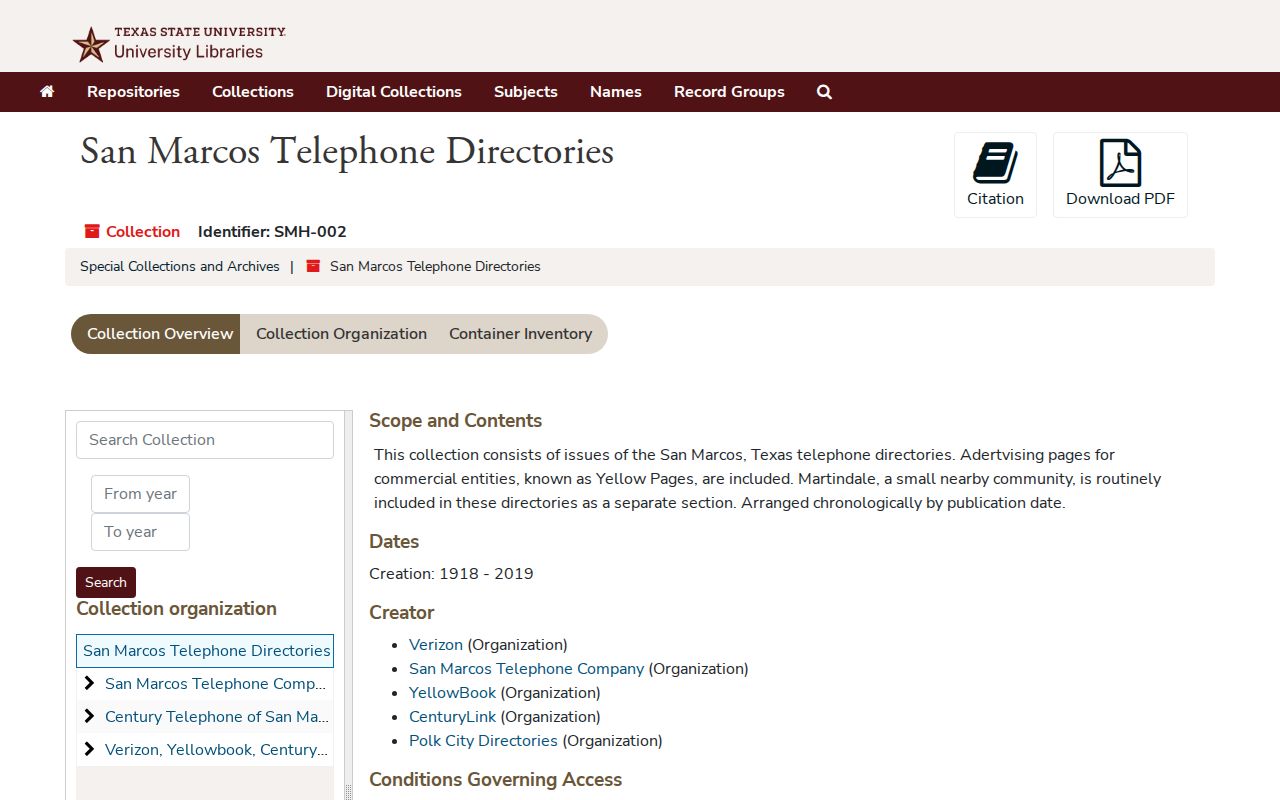
The collection-level view helps a researcher request the right issue first, then record the volume’s printed place and page rather than treating the archive description as an individual listing.
UT Barker’s San Marcos directory holdings citation identifies the individual years and ranges available through that repository.
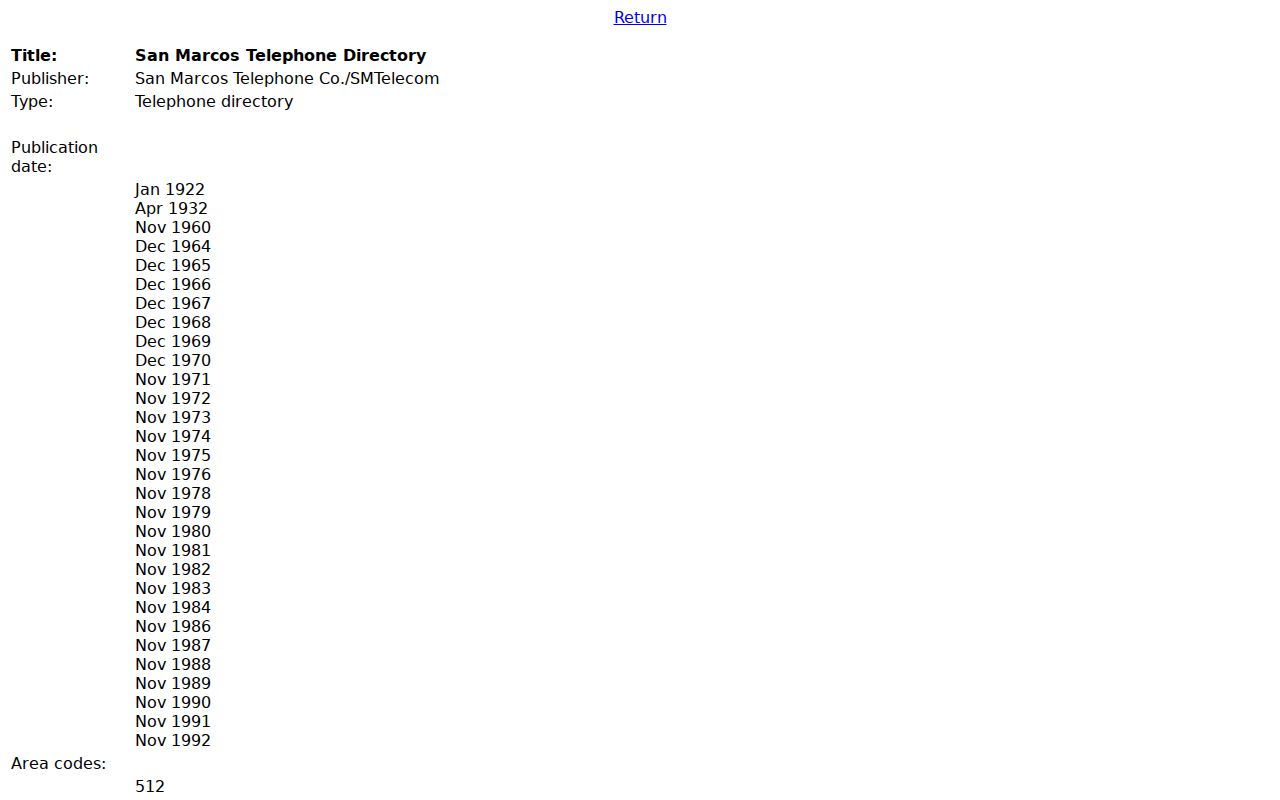
Its issue-level display is a reminder to request the listed volume, then inspect the actual page before treating a name, number, or printed place as a historical fact.
Reading a San Marcos Directory
A directory entry is a dated transcription, not a current profile. The Texas State Library’s directory guide identifies common fields such as name, address, telephone, and spouse. San Marcos collections also include alphabetical telephone issues, business material, Yellow Pages, and nearby-place sections. Exact abbreviations, occupancy marks, widow notation, and work lines vary by publisher and year, so read the key in the same volume before assigning a meaning.
| Directory citation | Title or publisher, year, page or image, and printed place |
|---|---|
| Printed name | Record the name exactly, including initials, suffixes, and relationship notation if shown |
| Address and telephone | Capture both as printed, along with street suffixes and unit details when present |
| Context fields | Section heading, spouse notation, business or work line, and nearby entries only when printed |
| Publisher marks | Abbreviation key plus any occupancy or widow notation, without assuming it applies to another year |
The 1941 San Marcos Telephone Company PDF is an image-based primary scan. No individual entry was transcribed in the research because it must be read page by page. That restraint prevents a blurred name or number from becoming a false family-history claim.
Note: Keep the abbreviation key with the entry citation because its meaning may change between publishers and even between issues.
San Marcos Directory Terms
Directory vocabulary changes by publisher. Use the words in the book before using any shorthand in a research note.
- Criss-cross directory
- An address-ordered section, when a volume provides one, that can be checked after finding a name in the alphabetical section.
- Householder index
- An arrangement focused on the listed household name. It may omit people or details that appear elsewhere in the same volume.
- Abbreviation key
- The publisher’s explanation of shortened labels and marks. Photograph or transcribe it from the issue being used.
- Printed place
- The town or community named in the directory. This field helps separate San Marcos entries from Buda, Kyle, Martindale, Wimberley, and other places included in some collections.
A directory result that needs a present-day address check should shift to the modern address records rather than stretching an old listing forward. The San Marcos street directory route handles that address-based work.
Tracing San Marcos Directory Households
Use at least three issues for a household trace: the earliest address hit, a middle issue that continues or changes the entry, and the latest issue available. Start with the known name or address, then search the residential alphabetical section, business section, and any reverse pages. Compare the address across years, but label a move, renumbering, or omission as an inference until another source supports it.
- Choose a San Marcos issue close to the known year and record the full citation before copying any field.
- Search the name and address in the next available issue, including normal street-name variants and the printed place.
- Use a reverse or criss-cross section only if that volume provides one, then note nearby entries as historical context.
- Pair the directory sequence with the relevant census decade and preserve any mismatch instead of forcing a match.
- Resolve a surname, telephone, street suffix, unit, or place-label change with a second anchor such as a deed, obituary, cemetery inscription, census, or parcel record.
A listing that disappears may reflect a move, death, changed service, missing issue, or an unlisted household. The best next source depends on the question. For a modern one-person verification after a historical lead, use the San Marcos resident lookup workflow and keep the historical date attached to the directory result.
San Marcos Directory Endpoints
Obituary and burial sources help distinguish people with the same name and can explain the end of a directory trail. The local obituary collection runs from the early twentieth century into the 1980s and draws on the San Marcos News, Daily Record, Hays County Citizen, Kyle News, Wimberley View, and Free Press. Local history notes that Hays County newspapers and microfilm are held locally. Search the index first, then inspect the notice or microfilm page before recording a date or relationship.
San Marcos’s burial-record map is available online at all hours and supports partial wildcard and exact searching. Its city data may omit older entries from before the city took over records in the late 1970s. Cross-check a result with the Local History collection and Historical Commission material, especially when the date or cemetery attribution matters.
San Marcos Directory Timeline
The directory record is more varied than a single publisher sequence. Its changing formats explain why a careful trace cites both the repository and the issue.
- 1899: The local telephone directory appears as a single printed sheet.
- 1905: Two early telephone companies are documented in San Marcos.
- 1918–2019: TXST SMH-002 provides a chronological telephone-directory collection.
- 1922–1992: UT Barker lists selected San Marcos Telephone Company issues across the specified years and ranges.
The time line supports a practical rule: compare like with like before drawing a conclusion. A single service sheet, a Yellow Pages section, and an alphabetical telephone directory do not make the same claim about a community or family.