
Finding San Marcos Residents by Record
A San Marcos residents directory works best when the first search fits the question. For an address, start with the Hays CAD record, then compare the parcel’s situs and legal-description fields with the tax and GIS records. For a recorded sale, use the County Clerk’s EagleWeb index. For an older household, begin with a directory year or obituary date at the local-history collection. Each source ties a person to a different event, so a record can support a careful lead without proving that someone lives at an address now.
Keep a short note for each result: the custodian, record type, date, spelling used, and what was displayed. That habit makes it easier to separate two people with the same name. It also makes a blank portal result useful. A missing entry can mean the source has a date gap, an identity gate, a protected field, or a different county office, rather than proving that no record exists.
- Use an address or owner spelling in Hays CAD to identify the parcel and its current appraisal record.
- Check the county tax or GIS fields when a ZIP, legal description, or parcel geometry needs a second source.
- Search a deed party or recording date in EagleWeb, then view the underlying instrument if its legal wording matters.
- For a dated household question, compare local telephone directories, obituary indexes, cemetery inscriptions, and newspaper pages.
- Send a narrow request to the relevant custodian when the needed record is not posted online.
San Marcos Resident Records Offices
San Marcos is the Hays County seat, but record custody still changes by subject. The County Clerk holds deeds, liens, local vital records, assumed names, and county-court material. The District Clerk is the separate route for district civil and criminal matters, family records, and divorce decrees. Hays CAD maintains appraisal records, while Hays Elections operates a voter lookup with an identity check. The City’s search is useful for minutes, ordinances, and resolutions, not as a general resident list. The address chain is described in more detail in the San Marcos street directory.
Hays County Clerk Records
712 S Stagecoach Trail, Suite 2008
San Marcos, TX 78666
512-393-7330
Hays Central Appraisal District
County property and account records
Hays County, Texas
Property portal access
San Marcos Parcel Search Fields
Hays CAD is the useful first stop when a San Marcos address is known. Its public search separates Owner Name, Street Number, Street Name, Quick Ref ID, Property Type, Subdivision, Condo, Owner ID, Tax Year, and Neighborhood. The related tax search adds city, ZIP Code, property status, acreage, and legal-description controls. Those separate fields help narrow a parcel without turning an owner or mailing field into a claim about current residents.
The county parcel layer adds mapping context. It exposes owner, property ID, legal description, situs address, mailing address, tax year, year built, and value fields. Its polygons are especially useful for checking whether two address references describe the same parcel. The service metadata says the layer was acquired from TNRIS in February 2022 and last edited December 22, 2025. Record that date when relying on the display.
| Hays field | How it helps a San Marcos search |
|---|---|
| Owner Name | Finds an appraisal account under a name variant. |
| Street Number and Street Name | Locates a situs address without assuming a mailing address matches it. |
| Quick Ref ID or Property ID | Provides a stable county reference for comparing CAD, tax, and GIS records. |
| Subdivision and legal description | Helps bridge older street forms and deed searches. |
The Hays CAD public search separates owner, address, and reference fields before a search is run.
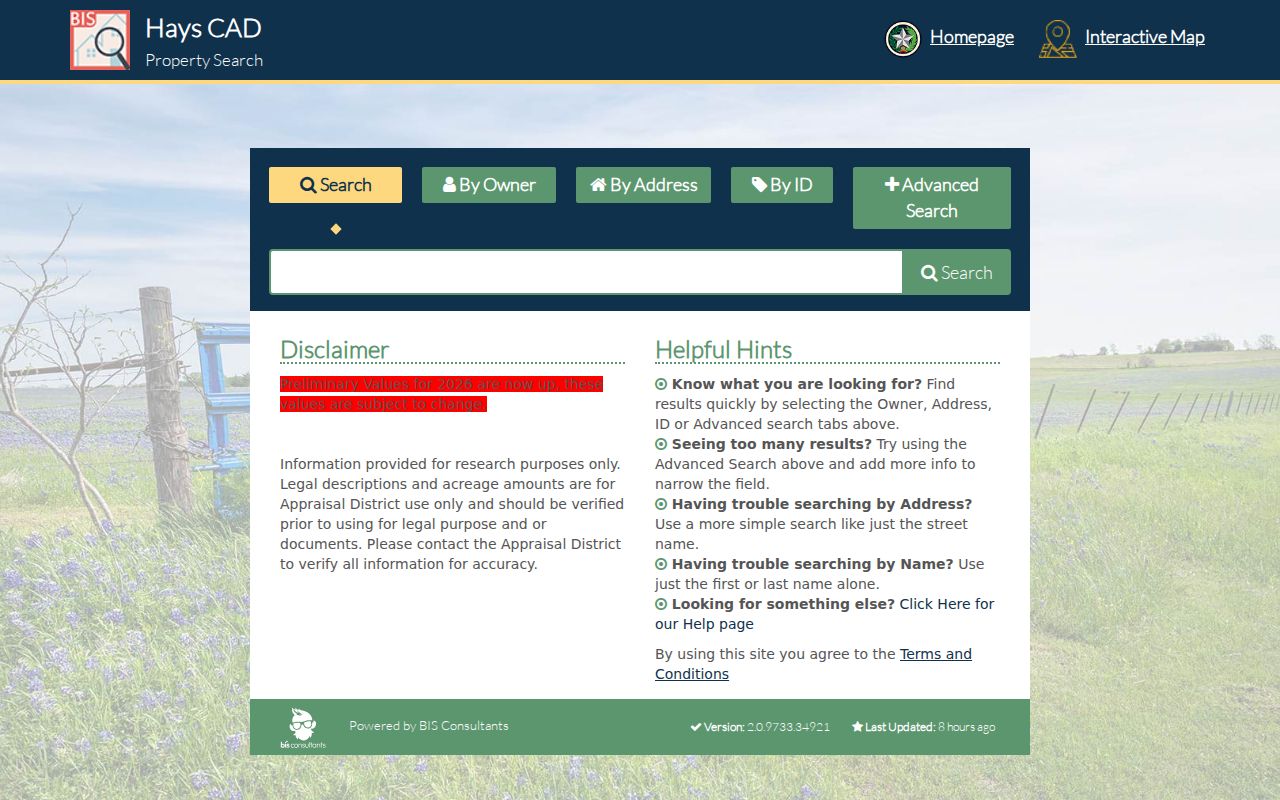
Those dedicated controls make a parcel search more precise than treating a San Marcos name as a general directory query.
Note: An appraisal account connects a person to property records, but it does not identify every San Marcos resident at that location.
San Marcos Voter Lookup Limits
The Hays voter lookup is deliberately narrow. It accepts an exact first and last name plus date of birth, or a ten-digit VUID plus date of birth. It is not a browseable street roll, and it should not be used to create one. The Hays interface is county-specific and lists elections@hayscountytx.gov as its contact route. A match relates to election registration, not an all-purpose statement that a person currently lives at a given San Marcos address.
Texas rules protect sensitive voter information. Social Security numbers and Texas driver-license or ID numbers are confidential; telephone numbers cannot be copied or transcribed; and qualifying people may have protected addresses. A date of birth can also be confidential in an individual request. A missing entry may therefore reflect the portal’s required inputs or a lawful protection. Use the official lookup only for its stated election purpose and keep personal fields out of a research note.
The Hays voter lookup shows its two identity-gated search modes.
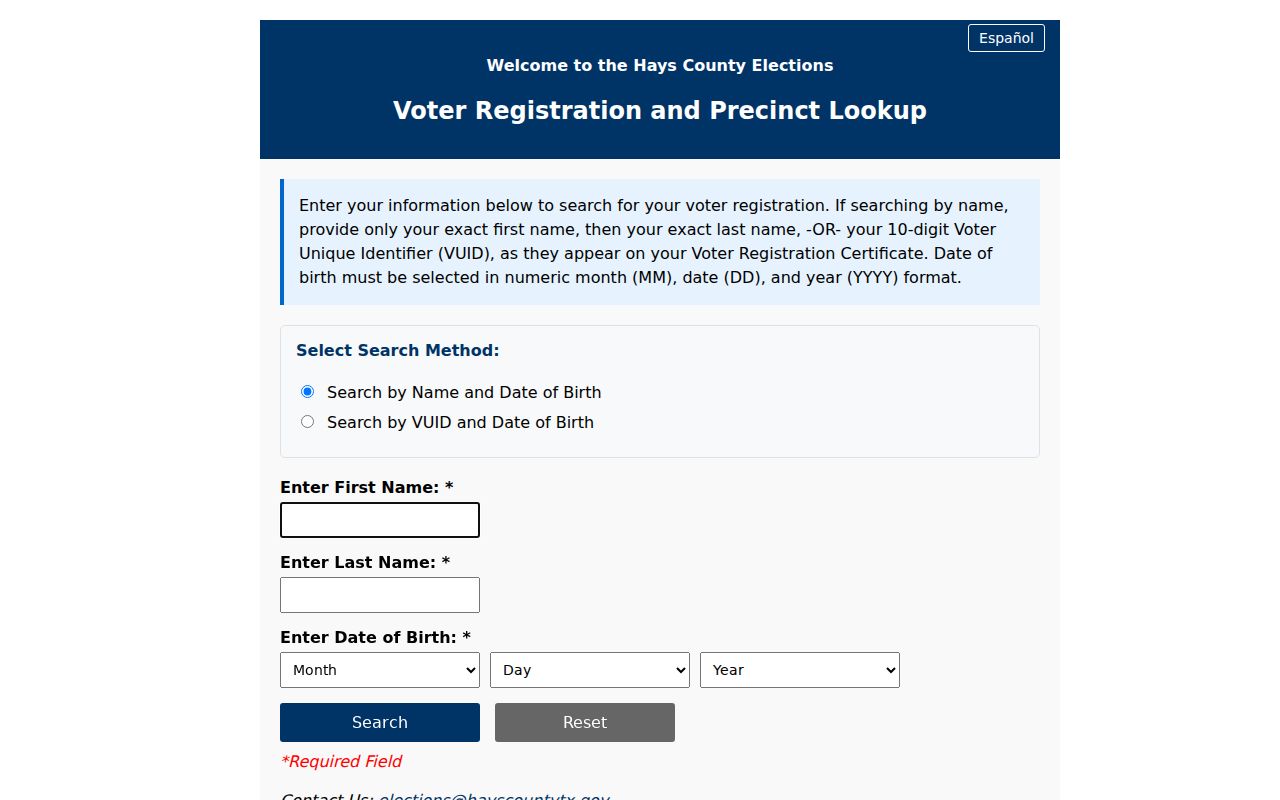
The required date-of-birth field is a reminder that this tool is not designed for a casual street or household browse.
Use records carefully. San Marcos research is for personal, lawful history and verification, never for stalking, harassment, threats, or revealing protected details.
San Marcos Deeds Since 1848
Hays County was organized in 1848, and EagleWeb indexes recorded documents from August 24 of that year. The recorder search can use Grantor, Grantee, or either party, a reception number, date window, document type, subdivision, block, and lot. Basic search keeps the words entered in order. Advanced search ignores word order and supports an asterisk wildcard, a required plus sign, and an excluded minus sign. “Find Related” can follow a legal description or related record into the next part of a title trail.
A grantor is the party transferring an interest. A grantee is the party receiving it. The index is a catalog, not the underlying deed. Search spelling variants, preserve the recording date and reception number, then ask the County Clerk for the actual instrument when the legal language or image matters. Hays County’s Fraud Guard can alert a user when recorded documents match a supplied name, but it is an alert, not a title opinion.
The County Clerk page links its records and court divisions with the official online routes.
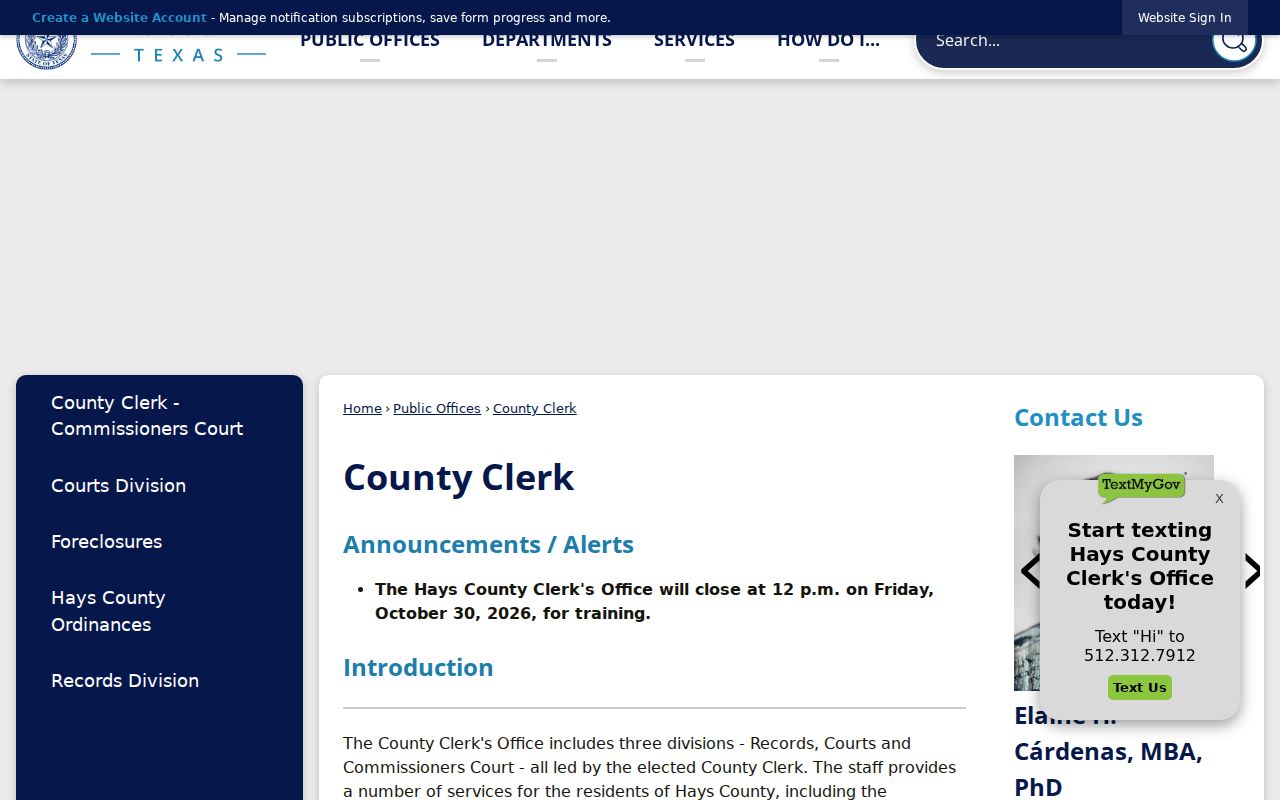
The division links matter because a deed, probate filing, and district court case are not necessarily kept by the same clerk.
- Parcel
- A county-defined piece of property used for appraisal and mapping.
- Index
- A finding tool that points to a record; it is not always the full document.
- Criss-cross directory
- A historical directory arranged by address rather than only by surname.
- Legal description
- The lot, block, subdivision, or other land description used to distinguish property.
Current San Marcos Resident Directories
There is no official master list of San Marcos residents. The current sources below are record-specific. Hays CAD and the tax search identify property accounts. EagleWeb identifies parties to recorded documents. The voter interface verifies an election record only after its required information is entered. City permits can identify an application or project at an address, while court files identify a party in a case. Keeping those meanings separate avoids treating a directory-like record as proof of current occupancy.
| San Marcos source | Record relationship | Custodian | Access path |
|---|---|---|---|
| CAD and tax records | Owner or account connected to a parcel | Hays CAD and Tax Office | Public property search |
| Voter lookup | Election registration for the exact required identity fields | Hays Elections | Name/DOB or VUID/DOB |
| EagleWeb | Grantor, grantee, and recorded-document party | Hays County Clerk | Online index, then custodian copy |
| City permit map | Application, status, and project location | City of San Marcos | Permit map, 2018 to present |
| District Clerk search | Party in a district court matter | Hays District Clerk | Online search, terminal, or request |
For a single person, compare at least two independent, dated sources. An address plus a directory year, a parcel plus a recorded instrument, or a case number plus its court are stronger than a name alone. The San Marcos resident lookup path focuses on that one-person verification work. The city’s public records search separately searches Council minutes, ordinances, and resolutions with asterisks for broad terms and quotation marks for exact phrases.
San Marcos City Records by Topic
City records supply the civic side of a San Marcos residents directory. The City Clerk’s online search covers Council minutes, ordinances, and resolutions. Use an asterisk to broaden a word or quotation marks for an exact phrase. If an item is not posted, the city directs requesters to Elizabeth Trevino at 512-393-8084 or its Public Information Requests route. That search can document an annexation, street change, public project, or neighborhood action. It does not function as a people index.
For a property-change lead, the City Permit Center uses MGO Connect. Applicants create an account, verify a phone number, select a category, upload materials, make a payment when due, and track inspections. The map shows applications from 2018 forward and can display a point, status, details, and aerial setting. An application or inspection status dates activity at a location. It is not proof of ownership, completed work, or who lives there.
The San Marcos record-search screen shows the city’s keyword controls.
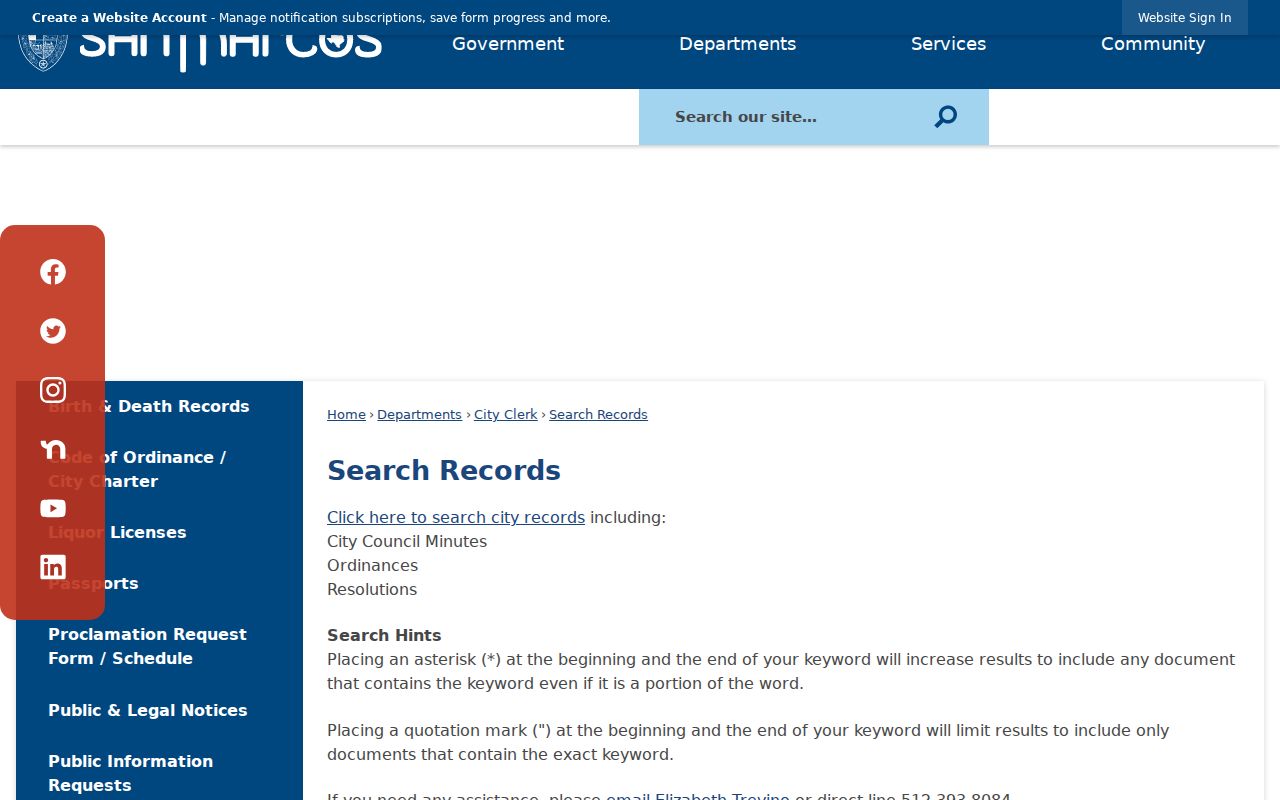
Use the exact-phrase and wildcard options to locate a city action, then preserve the meeting date and record type with the result.
San Marcos Records Have Boundaries
The same address can belong to several geographies. San Marcos is an incorporated city, a postal place, the Hays County seat, and the center of an extra-territorial jurisdiction. ZIP Codes 78666 and 78667 are San Marcos postal labels, but a mailing city does not establish a city-limit location. Hays GIS and 911 addressing, the City limits and ETJ map, and the parcel’s situs fields answer different geographic questions. The county tax search accepts a ZIP filter, but a filter is not a boundary decision.
Older records add another boundary. A historic address may use a changed street name, a different suffix, a lot and block, or a nearby landmark. The City’s street ordinance requires notice when annexation creates similar street names and the City changes a name. No official citywide renumbering year was found in the research, so do not invent one. Search the historical street form, legal description, and directory year together. That is safer than forcing a modern number onto an older record.
Note: A postal city, a GIS polygon, and a directory address each describe San Marcos differently, so record which geography each source uses.
San Marcos Vital and Court Trails
Some person-related records have strict access rules. Texas Government Code §552.115 makes a birth record public on the 75th anniversary and a death record public on the 25th anniversary, subject to exceptions. Hays County Clerk and the state offer different channels: local marriage copies come from the County Clerk, divorce decrees come from the District Clerk, and DSHS provides state verifications and orders. The DSHS online vital route accepts Texas events, requires an adult requester, and limits recent birth and death access to eligible people.
Court records also need a custodian check. Hays Odyssey separates Criminal Case Records, Civil/Family/Probate Case Records, Calendar, Jail, and Bond modules. The District Clerk offers public terminals and a paid office search for civil or criminal records from the past ten years. A docket links a party to a case. It does not prove guilt, a present address, or identity without matching the court, cause number, role, and dates. Sealed, juvenile, and protected records may not appear.
The DSHS fee table is the source for current state vital-record price information.
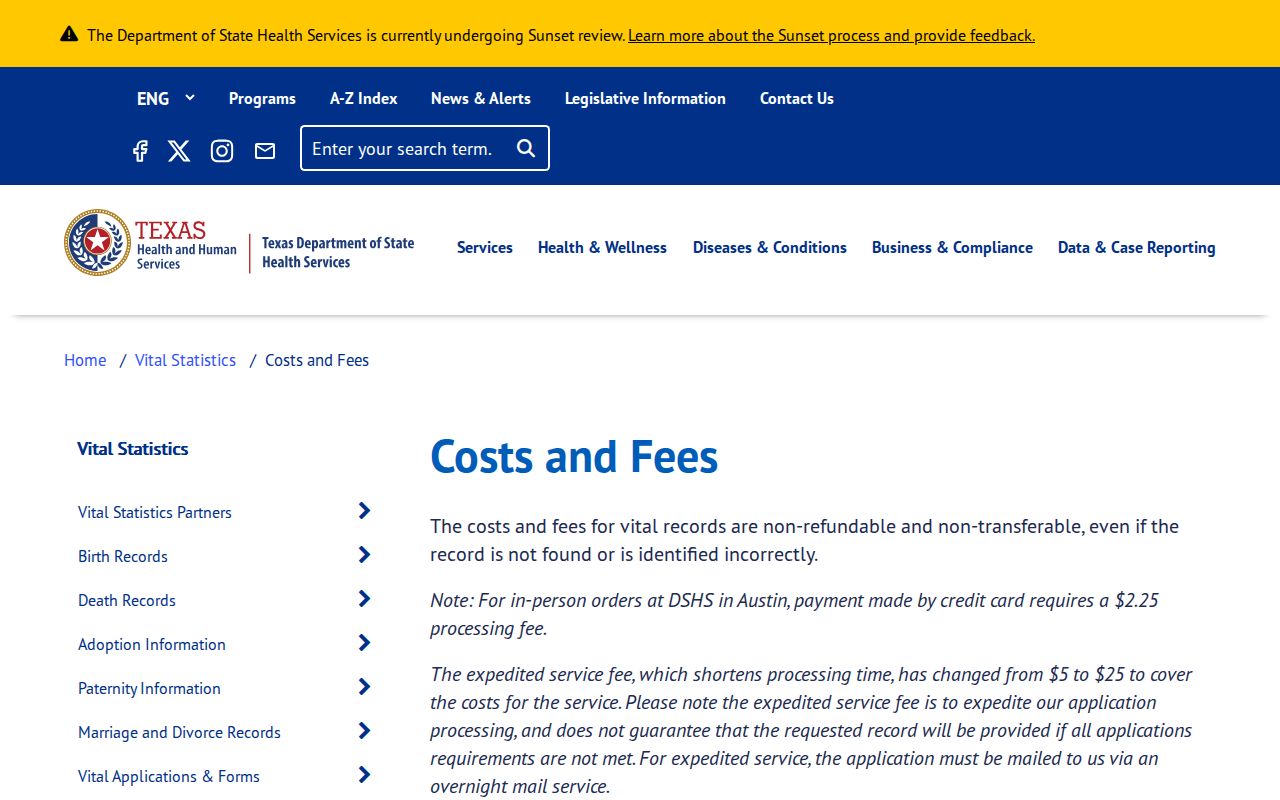
Check the live state fee and eligibility page at the time of an order because the correct record type and requester rule matter more than a name match.
San Marcos Archive Gaps and Fallbacks
A portal can be only the first access channel. The Texas Public Information Act, Government Code chapter 552, is the general route for agency-held information that is not already posted, subject to exceptions. Hays County lists GovQA, mail or hand delivery to the Office of General Counsel, email, and fax for its PIA path. A useful request identifies the agency, record type, date range, identifiers, format, and preferred delivery. Ask for an electronic copy or a narrow index before requesting a large set.
For early county series, the Texas State Library and Archives Commission’s Hays microfilm guide supplies a stronger fallback than guessing at an online coverage gap. It lists filmed deed records from 1848 to 1901, death records from 1903 to 1934, probate minutes from 1848 to 1930, tax rolls from 1848 to 1910, and other groups, with on-site and interlibrary-loan access. Hays courthouse history also helps explain why an original series, a later replacement index, and a digitized scan may differ.
San Marcos Official Records or Listings
A commercial search result may be convenient, but it is not a substitute for the record custodian. Commercial services can merge same-name people, keep stale address histories, omit protected records, or charge for a report without showing the record date and source. An official San Marcos or Hays County source has its own limits, yet it identifies the office, record type, access rule, and date range. Use a result as a lead, then return to the parcel, deed, court, voter, library, or city source that can answer the specific question.
| Source category | Useful for | Key limitation |
|---|---|---|
| Official county or city record | A dated property, filing, or civic-record relationship | Coverage and confidential fields vary by custodian. |
| Archive or library collection | Historical names, place labels, and date-bound context | An index or finding aid does not replace a scanned page. |
| Commercial search category | A possible lead to verify elsewhere | Accuracy, source date, and identity matching may be unclear. |
Note: A careful San Marcos residents directory trail preserves the original source, access date, and record date instead of repeating an unsourced summary.
Historical San Marcos Resident Directories
San Marcos historical resident directories are unusually strong for a city of its size. The local history collection has digitized telephone directories from 1899 through 1954, including a single-sheet 1899 directory and evidence of two early telephone companies after 1905. Texas State University’s SMH-002 San Marcos Telephone Directories collection runs from 1918 through 2019, with chronological issues, Yellow Pages, and a separate Martindale section. UT’s Barker holdings add issue-level citations for 1922, 1932, 1960, 1964 through 1970, 1971 through 1976, and 1978 through 1992.
A directory entry is a dated published statement. Read the printed place, name, address, telephone, spouse field, and section heading together, then compare at least three years before inferring a household move. ResCarta also gives access to obituary indexes and cemetery inscriptions, while the library has cataloged physical materials that are not digitized. The full archive methods and collection distinctions belong on the San Marcos city directory page.
The TXST directory finding aid establishes collection scope and access conditions. City actions can complement a historical directory, but each source still needs its own date, custodian, and scope note.